
50mm vs 100mm Cold Storage Panels: PU vs PIR Core Comparison Guide
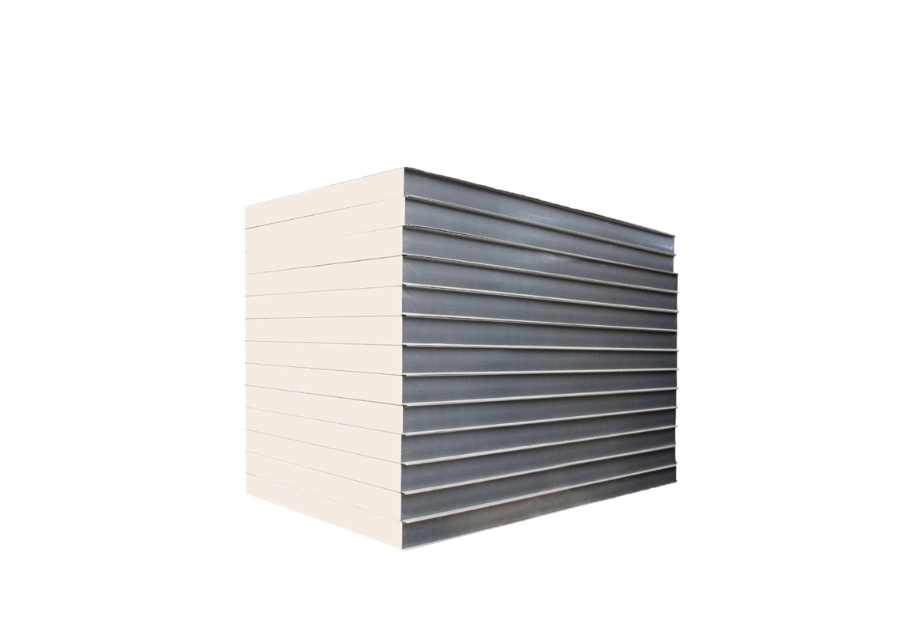
Cold room enclosure planning comes down to two parameters that are often treated as product grades. The first is panel thickness: 50mm or 100mm. The second is core material: PU or PIR. On the JSGREEN001 Cold Storage Panels platform supplied by Jiangsu Green Bio-Environmental Protection Technology Co., Ltd. — trading as GREEN BIO — both parameters are parallel configuration options, not upgrade tiers.
The short answer: 50mm and 100mm are not a good-versus-better pair. They correspond to different thermal insulation goals inside a working envelope of -50°C to +15°C, under 24/7 continuous operation, in facilities that also depend on a refrigeration unit and an air cooler. PU and PIR are two core options on the same panel platform, and the core material should follow the fire rating the project specifies — B1 or B2 — rather than habit or price alone. In all cases the declared thermal conductivity to check is ≤0.024 W/(m·K) on the quoted configuration.
Why the 50mm/100mm and PU/PIR decisions are often made badly
Three disconnects cause most specification errors on cold storage panel procurement.
1. Treating thickness as a quality tier. 50mm is not a cheaper version of 100mm. Both are listed thickness options on the same panel, and both are built around the same core materials with a thermal conductivity of ≤0.024 W/(m·K). Thickness is an insulation decision tied to the temperature band the room actually runs in, not a signal of build quality.
2. Treating PU and PIR as a brand promise. Both are specified core materials for JSGREEN001, and the fire rating is quoted separately as B1 or B2. The core choice therefore has to be read against the fire rating required for the room, not against a general preference for one polymer name.
3. Leaving effective width to the end. The two available effective widths, 960mm and 1100mm, decide how a wall is laid out in panels, which in turn decides how many joints have to be sealed. Width is frequently confirmed after pricing, when it is already fixed by the panel order.
What a cold storage panel actually has to survive
A cold storage panel is the enclosure structure of the room, not a decorative cladding. Its job is to block heat exchange between the inside and outside of the warehouse, hold a stable internal temperature, and reduce the load carried by the refrigeration equipment. Because the panel is part of a system rather than a standalone product, its specification is only meaningful alongside the equipment and accessories it works with.
The operating conditions the panel is designed against include a temperature range of -50°C to +15°C, covering frozen storage, chilled storage and quick-freezing storage. Relative humidity can reach ≤90%, so anti-condensation and anti-dew behaviour matters. Coastal high-salt-spray areas, industrial plants with vibration, and clean room storage areas are named as special environments that change how the enclosure is detailed.
Duty cycle is the part buyers underestimate. Cold rooms run 24/7, which means the panel has to hold long-term durability, anti-ageing performance, stable insulation and reliable sealing across continuous low-temperature operation — not just at commissioning.
The equipment that has to be coordinated with the panel
A cold room panel package is not a complete cold room. The panel decision sits alongside matched equipment that includes the refrigeration unit, air cooler, tube evaporator, temperature and humidity control system, dehumidifier, fire sprinkler system, cold storage door, loading platform door seal, sealing tape, fasteners and installation accessories. A refrigeration unit and air cooler are required for the room to function; the panel does not replace them, and quoting panels without them produces a specification that cannot be commissioned.
Where green building requirements enter the picture
Insulated cold storage enclosures now sit inside a broader green building framework. Under China's 14th Five-Year Plan, all new urban buildings are required to meet green building standards by 2025, and China's national green building evaluation is governed by GB/T 50378-2019, most recently updated in 2024, using a one-to-three-star rating. Green Building Solutions procurement in this category is therefore increasingly judged on documented insulation performance, material composition and management-system evidence rather than on the enclosure alone.
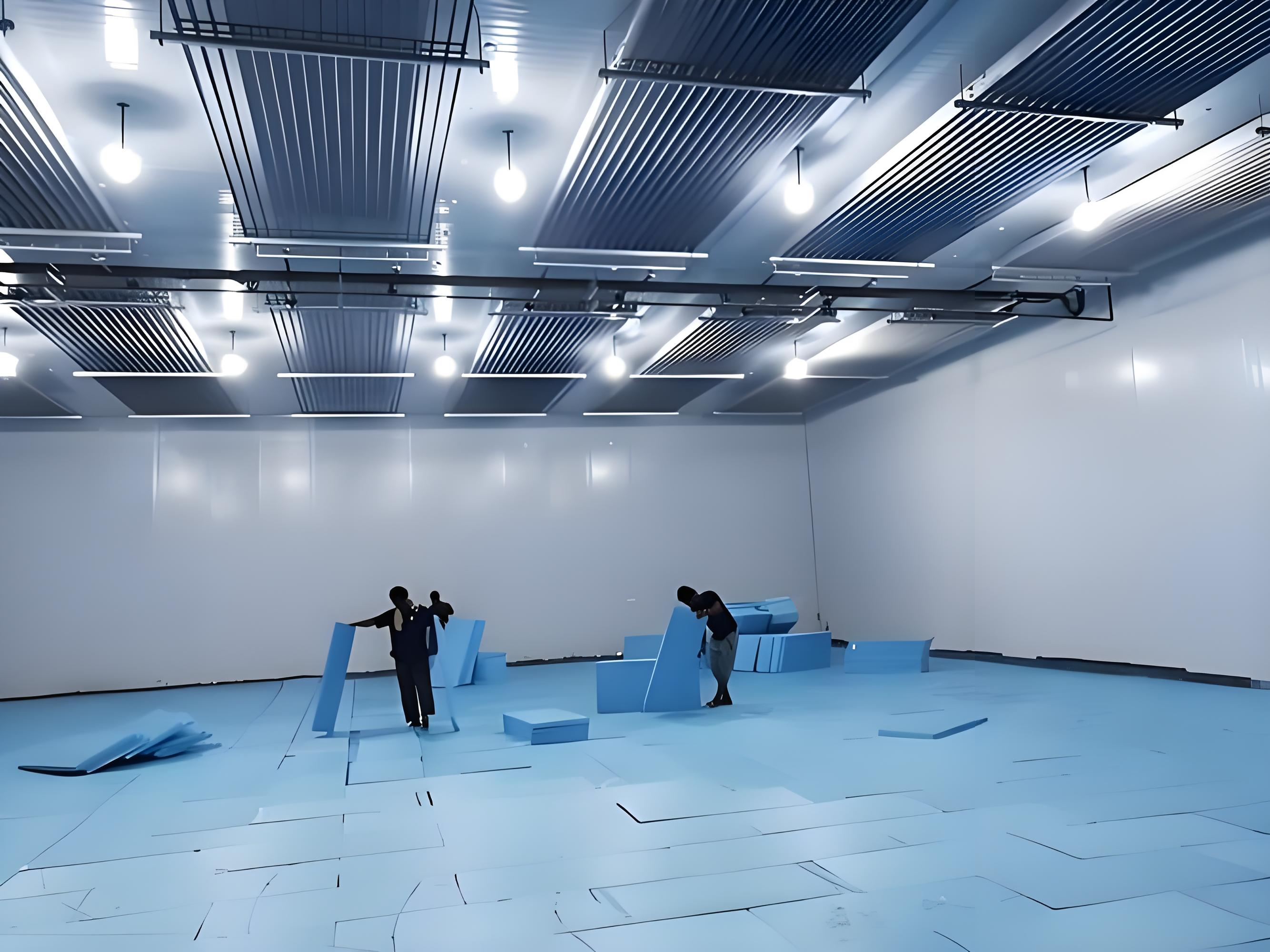
JSGREEN001: four specification decisions to compare one by one
The JSGREEN001 Cold Storage Panels are described as fire-retardant B1-grade PIR panels made from rigid polyurethane, with a PU or PIR core. Fire rating is quoted as B1 or B2, thermal conductivity as ≤0.024 W/(m·K), panel thickness options as 50mm and 100mm, steel sheet thickness as 0.5mm, and effective width as 960mm or 1100mm. The four decisions below map onto those declared values.
Decision 1 — Core material: PU vs PIR
The core is the insulation body of the panel, and JSGREEN001 offers it in PU or PIR. Both are rigid polyurethane-based foam systems, and both are listed with a fire rating of B1 or B2 and a thermal conductivity of ≤0.024 W/(m·K). This is the important structural point for buyers: the core name and the fire rating are quoted as separate attributes, so a PIR core does not automatically deliver any given rating class. The rating has to be confirmed on the specific configuration being ordered.
In practice, the core choice should follow the compliance question first. If the project specification calls for a B1 fire rating, confirm that the quoted build achieves B1. If B2 is acceptable, both cores remain in scope. Where the two options are otherwise comparable on paper, the deciding factors are usually the fire documentation package the project requires and the total enclosure cost at the chosen thickness.
Decision 2 — Thickness: 50mm vs 100mm
JSGREEN001 is offered at 50mm and 100mm thickness, and panel thickness can be customised across a wider 50mm to 200mm range for project requirements. Thickness is the insulation-depth decision. At a fixed thermal conductivity of ≤0.024 W/(m·K), a thicker panel provides a greater insulation section across the same wall area, so the room carries less heat gain per square metre of envelope.
That is not the same as saying 100mm is always correct. Two practical constraints pull the other way. Thicker panels consume more usable internal floor area and clear height for the same external footprint, and they change the detailing at doors, corners and penetrations. On a room running near the +15°C end of the range, 50mm may satisfy the insulation target with a smaller space penalty. On a room running toward the -50°C end, the insulation section matters more, and 100mm — or a custom thickness within the 50mm to 200mm band — is the configuration to evaluate.
The case evidence supports the thickness-quality separation directly: a 5,000 sqm cold storage panel installation serving a 2,000-ton capacity facility has run stably for five years across low-temperature freezer (-18°C) and chiller room (0–4°C) zones, with precise temperature control and seamless joints preventing cold air leakage. The panel build in that project combined high-strength double-sided colour steel sheets with precision foaming to deliver flatness and load-bearing capacity — properties that belong to the whole panel build, not to thickness alone.
Decision 3 — Effective width: 960mm vs 1100mm
Two effective widths are available: 960mm and 1100mm. Effective width determines how a wall face is divided into panels, and therefore how many joints run vertically across that face. A wider panel means fewer panels and fewer joints for the same wall length, which shortens the sealing line and the associated tape and fastener work. The trade-off is handling: wider panels are more demanding to move and position on site, so the chosen width has to match the access and lifting arrangements on the project.
Width also interacts with installation schedule. The modular, standardised design of JSGREEN001 panels increases on-site installation speed by 30% according to project case records, and that benefit depends on the panel module being planned before fabrication rather than adjusted during erection. On a 12,000 sqm sorting centre project delivered to a 3PL cold chain logistics client, on-schedule delivery and straightforward installation were reported alongside improved cargo turnover efficiency.
Decision 4 — The 0.5mm steel sheet and wet-service durability
The panel thickness is quoted as 0.5mm steel sheet, and the closed-cell core structure is what resists water vapour penetration in high-humidity rooms. This matters because relative humidity in cold storage can reach ≤90%, and moisture ingress into an insulation core degrades performance over time in a way that is invisible at handover. The declared requirements for this duty include high humidity resistance through the closed-cell structure, good air-tightness to reduce cold air leakage, and a clean, hygienic surface for food, pharmaceutical and clean room applications.
For coastal high-salt-spray areas and low-temperature chemical storage, anti-corrosion performance becomes an additional selection criterion on top of the standard build. That requirement should be stated at enquiry stage, because it affects the steel specification and finish rather than the core alone.
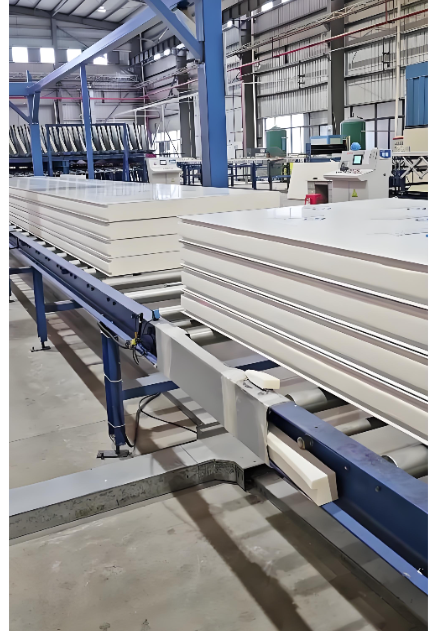
Step-by-step selection process
The sequence below converts the four decisions into a repeatable specification workflow. It is written for a procurement or engineering team preparing an enquiry, not for a fabricator.
- Lock the operating envelope. Record the design temperature band within -50°C to +15°C, the expected relative humidity (up to ≤90%), and whether the room is frozen, chilled or quick-freezing duty. Note any special condition: coastal salt spray, vibration, or clean room classification.
- Set the fire rating before the core. Confirm whether the project requires B1 or B2. Only then choose between PU and PIR, and require the rating to be stated on the quotation for that configuration.
- Choose the insulation depth. Compare 50mm and 100mm against the insulation target and the internal space budget. If neither fits cleanly, the customisation range extends from 50mm to 200mm.
- Fix the width from the wall layout. Take the 960mm or 1100mm effective width and lay out each wall face to count joints. Confirm the choice against site handling and lifting arrangements.
- Confirm the steel and finish. The 0.5mm steel sheet is the declared base. Where corrosion resistance is required, specify the steel colour and material through the OEM/ODM route rather than accepting the default.
- Coordinate the matched equipment. Confirm the refrigeration unit, air cooler, tube evaporator, temperature and humidity control system, dehumidifier, fire sprinkler system, cold storage door, door seal, sealing tape, fasteners and installation accessories in the same package review. Panels alone cannot be commissioned.
- Verify supplier evidence. Check certification numbers, the quality-control sequence, sample availability and lead time in writing before the purchase order.
Matching the configuration to the application
JSGREEN001 cold storage panels are specified across five industry groups. The configuration logic differs by application because the temperature band, humidity profile and compliance evidence required differ.
Food and beverage
Meat, seafood, dairy, fruit, vegetable and beverage processing rely on the panel to hold stable temperature across freezer and chiller zones. The enclosure specification matters here because food shelf life is directly affected by temperature stability — application data records shelf life extended by more than 50% in controlled conditions. Hygienic, cleanable surfaces and air-tightness are the practical requirements on top of insulation.
Pharmaceuticals
Vaccines, medicines and biological products require strict temperature control, and GSP cool storage and cold storage rooms are a named project type. The documented case of a food-processing installation passing GSP certification after commissioning illustrates the pattern: the enclosure has to support an auditable, verifiable temperature environment, not just an insulated box. Certification evidence on the panel supplier side should be reviewed together with the room validation plan.
Logistics and warehousing
Cold chain logistics centres, distribution hubs and supermarkets often run multi-temperature layouts — frozen, chilled and ambient in one building. Multi-temperature distribution centres are a named project type, and the width and module decisions become more consequential because wall layouts repeat across many rooms. The 12,000 sqm sorting centre case is representative of this pattern.
Chemical industry
Storage of low-temperature chemical raw materials places weight on corrosion resistance and sealing integrity. Where the facility is in a coastal high-salt-spray area, the steel specification and finish should be confirmed explicitly at enquiry stage.
Agriculture
Seed storage and agricultural product preservation, including agricultural pre-cooling facilities, typically operate at the less extreme end of the temperature range. This is where 50mm configurations and standard builds are most often evaluated against the insulation target, with the final choice still driven by the room's design temperature and duty cycle.
Configuration comparison table
The table below compares the declared JSGREEN001 parameters. It deliberately does not assign performance grades to individual combinations, because the correct combination depends on the project's fire rating, temperature band and layout rather than on an inherent ranking.
| Parameter | Declared value | What it decides in the specification |
|---|---|---|
| Core material | PU or PIR | Core selection, read together with the required fire rating |
| Fire rating | B1 or B2 | Compliance target; must be confirmed per ordered configuration |
| Panel thickness options | 50mm and 100mm (custom range 50mm–200mm) | Insulation depth versus internal space and detailing |
| Steel sheet thickness | 0.5mm | Surface durability, flatness and cleanability |
| Thermal conductivity | ≤0.024 W/(m·K) | Insulation baseline shared across thickness options |
| Effective width | 960mm or 1100mm | Wall layout, joint count and site handling |
| Operating temperature range | -50°C to +15°C | Frozen, chilled and quick-freezing storage suitability |
| Relative humidity | ≤90% | Anti-condensation and anti-dew detailing |
| Coordination requirement | Refrigeration unit and air cooler required | Panel package cannot be commissioned alone |
PU versus PIR at a glance
| Selection criterion | PU core | PIR core |
|---|---|---|
| Listed as JSGREEN001 core option | Yes | Yes |
| Fire rating on the product data | B1 or B2 | B1 or B2 |
| Thermal conductivity on the product data | ≤0.024 W/(m·K) | ≤0.024 W/(m·K) |
| Available thickness options | 50mm, 100mm | 50mm, 100mm |
| How to decide | Confirm against project fire rating and documentation requirements | Confirm against project fire rating and documentation requirements |
Do not treat certification as paperwork
For a cold room enclosure, management-system certification is a selection filter rather than a formality. The JSGREEN001 Cold Storage Panels are certified to ISO 9001:2015 (GB/T 19001-2016 idt ISO 9001:2015), certificate number NO.110825Q0383R0S; ISO 14001:2015 (GB/T 24001-2016 idt ISO 14001:2015), certificate number NO.110825E0251R0S; and ISO 45001:2018 (GB/T 45001-2020 idt ISO 45001:2018), certificate number NO.110825S0254R0S. All three were issued by Jiangsu Taiding Certification Co., Ltd., apply to the global market, were issued on 2025-09-25 and expire on 2028-09-24.
Read those three certificates for what they actually cover: quality management, environmental management, and occupational health and safety management across the sales of metal materials and hardware and electrical machinery and the processing of environmental protection equipment accessories. They are evidence that a management system exists and is audited. They are not a performance guarantee for a specific panel configuration, and they do not replace a fire rating declaration, a thermal conductivity figure or a project-specific test report.
Frequently asked questions
What is the difference between a CE-certified manufacturer and an ISO-certified one, and what should buyers verify?
They are different categories of evidence. The certificates recorded for JSGREEN001 Cold Storage Panels are ISO 9001:2015 (NO.110825Q0383R0S), ISO 14001:2015 (NO.110825E0251R0S) and ISO 45001:2018 (NO.110825S0254R0S), all issued by Jiangsu Taiding Certification Co., Ltd. for the global market. These are management-system certifications covering quality, environmental and occupational health and safety management. A CE marking is a separate product-compliance declaration for the European market and requires its own declaration of conformity and supporting test evidence. An ISO certificate does not substitute for CE documentation. Buyers evaluating CE-certified Green Building Solutions manufacturers should request the declaration of conformity and test reports for the specific configuration being supplied, and verify the management-system certificate numbers separately.
Can JSGREEN001 panels be customised to a project specification?
Yes. GREEN BIO operates OEM/ODM production for JSGREEN001 Cold Storage Panels, with customisation covering panel thickness, steel sheet colour and material, fire rating, custom dimensions and lengths, and cam-lock types. Monthly capacity is 50,000 square metres. The standard product data lists 50mm and 100mm thickness options, while the customisation range extends to 50mm–200mm, so a project that needs an intermediate thickness can specify it rather than choosing between the two standard options.
What is the minimum order quantity, and what drives the commercial terms?
The minimum order quantity is 100 square metres, or one 20ft container. Commercial terms are driven mainly by the configuration rather than by volume alone: core material, fire rating, panel thickness, effective width and steel specification each change what is being quoted. Because the declared values for thermal conductivity and fire rating must appear on the quotation for the ordered configuration, buyers should compare quotes on a configuration-matched basis rather than on a headline price per square metre.
How can a buyer verify panel quality before shipment?
The quality-control sequence runs through four stages: incoming raw material inspection, in-process patrol inspection, full inspection of finished product density and dimensions, and pre-shipment photo confirmation. Buyers who want independent verification before committing to a full order can request samples and a pre-shipment photo record. After delivery, installation guidance videos and remote technical support are provided, and damaged parts are replaced free of charge during the warranty period.
What is the lead time, and how quickly can installation proceed?
Lead time is 15–25 days after receiving the deposit. Installation speed depends on the panel module being planned before fabrication: the standardised modular design of JSGREEN001 panels increases on-site installation speed by 30% according to case records, and a 12,000 sqm sorting centre project was delivered on schedule with straightforward installation. To plan a project timeline, send the room layout, temperature band and required fire rating to the GREEN BIO team through the contact details on www.greenlvgreen.com, and the panel schedule, matched equipment list and delivery window can be reviewed together.
Conclusion: decide in the order the constraints arrive
The comparison between 50mm and 100mm cold storage panels, and between PU and PIR cores, is a comparison of constraints rather than of grades. On the JSGREEN001 platform, both thickness options and both core options sit under a shared thermal conductivity declaration of ≤0.024 W/(m·K), a shared operating range of -50°C to +15°C, and a fire rating quoted as B1 or B2 per configuration. The correct combination follows from the room's fire rating requirement, its insulation target, its duty cycle under 24/7 operation, and the way the 960mm or 1100mm effective width divides the walls that have to be sealed.
What separates a workable specification from an expensive correction is the order of decisions and the quality of evidence attached to them. Fix the fire rating, fix the insulation depth, fix the width, coordinate the refrigeration unit and air cooler, and then verify the supplier against certificate numbers, quality-control steps and a real lead time. That sequence is what makes a cold room enclosure a documented Green Building Solutions decision rather than a price comparison.
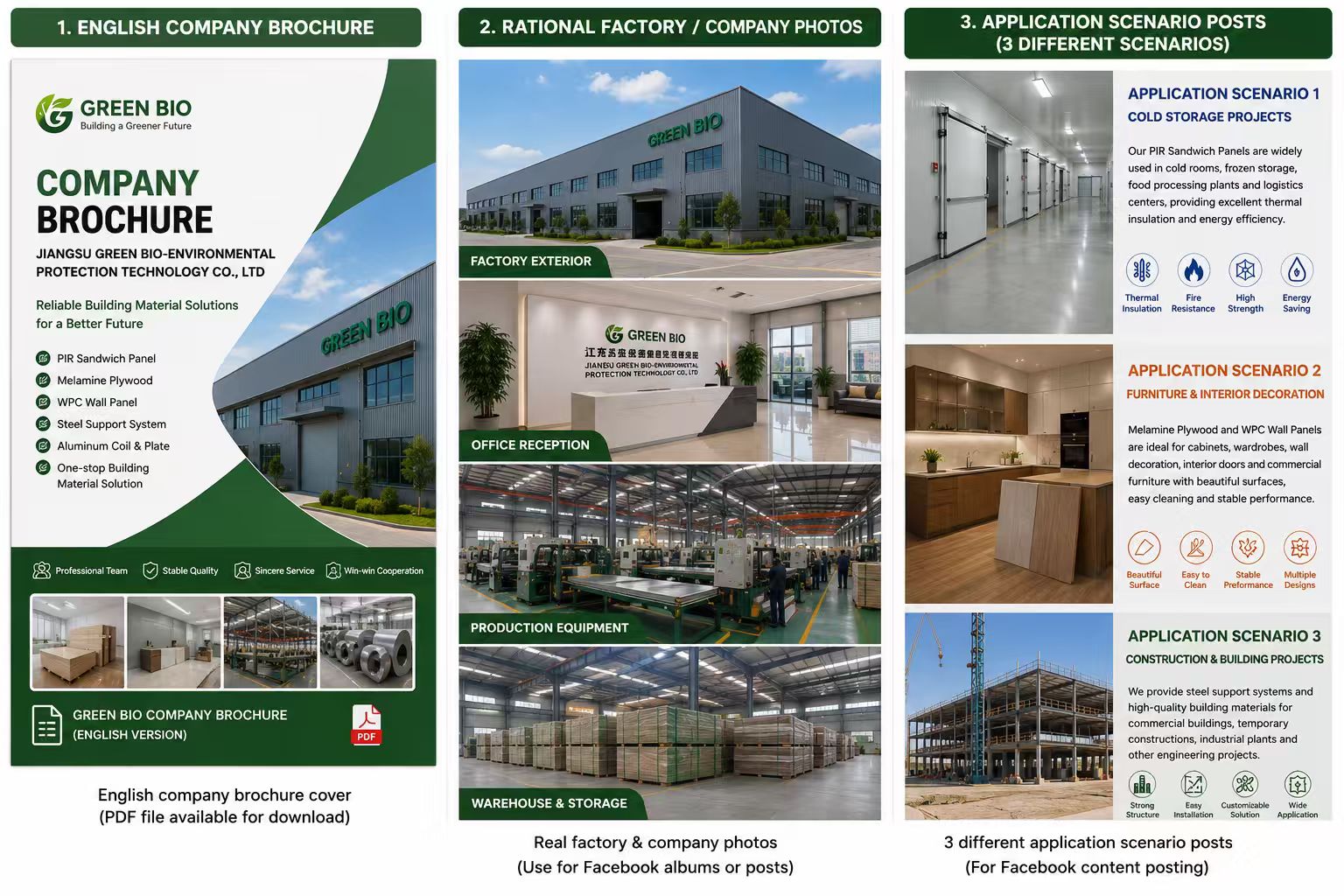
Next step: request a configuration-matched quote or sample
Share the room temperature band, required fire rating, wall layout and target thickness, and the GREEN BIO team will return a configuration-matched panel schedule, matched equipment list and delivery window. Full product specifications, panel options and project references are in the catalogue.
Download the GREEN BIO 2026 product catalogue (PDF)
Email: sunnylvgreen@163.com | WhatsApp: +852 55715742 | Website: www.greenlvgreen.com
Have Questions or Need More Details?
Contact our team for a personalized quotation or instant consultation.
Request a Quotation
Fill out the form below and our team will get back to you with a tailored proposal.
WhatsApp Direct Chat
Prefer to chat in real-time? Message us on WhatsApp for instant assistance & quick answers.
- Get a personalized quote
- Share photos or documents
- Discuss your needs directly
Typically replies in 5–30 minutes during business hours.