
PU vs PIR Cold Storage Panels: A Green Building Solutions Head-to-Head for Cold Chain Projects
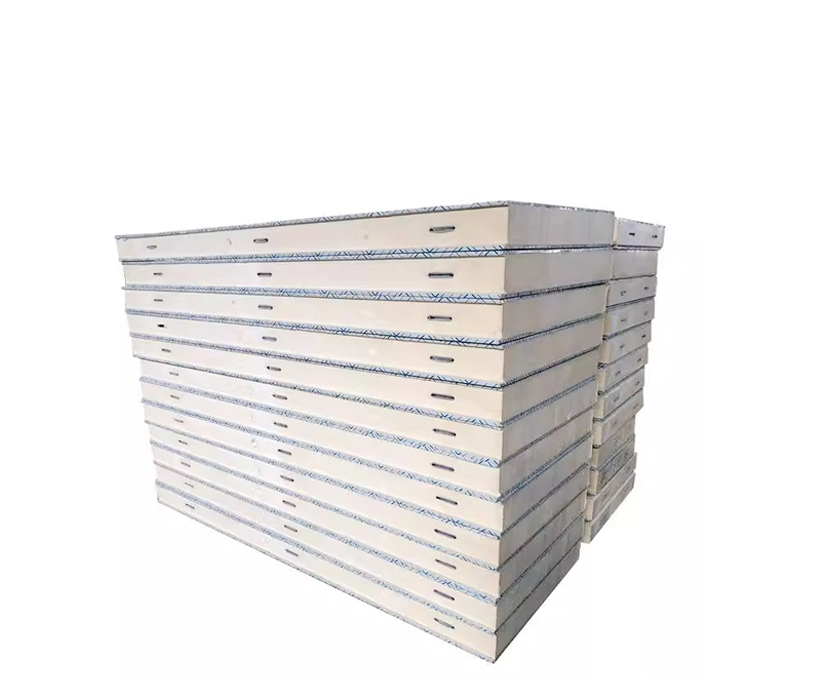
JSGREEN001 cold storage panels: a shared platform for PU and PIR core selection in cold chain projects.
Choosing between PU and PIR cold storage panels is a constraint-matching exercise, not a materials debate. Both cores are supplied inside the same JSGREEN001 Cold Storage Panels platform from GREEN BIO: rigid polyurethane chemistry with either a PU or a PIR core, 0.5mm steel sheet facings, 50mm or 100mm thickness options, 960mm or 1100mm effective width, a thermal conductivity of ≤0.024 W/(m·K), and fire rating options of B1 and B2, including a B1-grade fire-retardant PIR configuration. What actually changes between the two options is how the specified core satisfies the fire, temperature, hygiene, and documentation constraints that a cold chain project has to prove before handover.
GREEN BIO — formally JIANGSU GREEN BIO-ENVIRONMENTAL PROTECTION TECHNOLOGY CO., LTD — is a Jiangsu-based supplier of building envelope and finishing materials, founded in 2015. Its product range covers PIR sandwich panels, plywood, steel supports, cable brackets, and aluminum profiles, produced at a 10,000 m² facility with a 25-engineer R&D team and an annual output of 120,000 units. Around 70% of that output serves export markets concentrated in Southeast Asia, Central Asia, Russia, South America, and Africa — markets that overlap heavily with Belt and Road economies and other emerging construction regions.
Problem Definition: What a Cold Chain Envelope Must Actually Prove
A cold storage panel is not a cladding accessory. It is the enclosure structure of the facility, and its core function is to block heat exchange between the indoor and outdoor environment, hold a stable internal temperature, and reduce the energy consumption of refrigeration equipment. In documented cold chain operation, the energy saving rate of a correctly specified envelope can reach more than 30%, and a temperature- and humidity-controlled storage space can extend food shelf life by more than 50% while supporting pharmaceutical compliance requirements.
Operating conditions define the constraint set. Panels in this class are specified for a working temperature range of -50°C to +15°C, covering frozen storage, cold storage, and quick-freezing storage. Relative humidity can reach ≤90%, so anti-condensation and anti-dew behaviour matters as much as nominal insulation value. Operation is 24/7 and continuous, which turns long-term durability, anti-ageing performance, stable insulation, and reliable sealing into project-critical requirements rather than optional extras.
Special environments add further constraints. Coastal high-salt spray areas demand corrosion resistance; industrial plants with vibration demand mechanical stability; clean room storage areas demand a clean and hygienic surface. Each of these conditions changes what the panel must resist, and each should be written into the specification before a core type is selected. That is why a PU versus PIR decision made on material preference alone tends to be revisited during commissioning.
Industry Background: Why Cold Chain Envelope Specification Is Tightening
Green building materials in China are no longer a niche segment. The China green building materials market reached USD 216.3 billion in 2025 and is projected to reach USD 484.9 billion by 2034, according to IMARC Group. A narrower measure of the China green building market covering integrated systems and services was valued at USD 69.13 billion in 2024 and is projected to reach USD 147.86 billion by 2032, per Markets and Data. Those two figures are not interchangeable: estimates diverge because segment definitions differ, and Grand View Research sizes a considerably narrower slice of the same category. Buyers comparing market reports should check what each number includes before using it in a business case.
Policy is a stronger driver than market size. China has mandated that 100% of new urban buildings meet green building standards by 2025 as part of the 14th Five-Year Plan, according to the International Trade Administration. The national assessment framework behind that requirement, GB/T 50378-2019 “Assessment Standard for Green Building”, establishes four certification grades — Basic, 1-Star, 2-Star, and 3-Star. In practice this means envelope performance is now a scored project input rather than a supplier marketing claim.
Cross-border cold chain projects face the same pressure. The Third Belt and Road Energy Ministerial Conference in October 2024 adopted the Green Energy Cooperation Action Plan (2024–2029) to scale green infrastructure across Belt and Road markets — the same regions where GREEN BIO concentrates its export activity.
For a cold chain build, this background has one practical consequence: the envelope must be defensible on paper as well as in operation. Insulation performance, fire behaviour, and documentation are checked by project reviewers, not just by the operations team. That is the reason the PU vs PIR question is usually settled by declared fire rating and certificate scope first, and by unit price second.
The JSGREEN001 Platform: What Both Core Options Share
JSGREEN001 is GREEN BIO’s cold storage panel, classified within a fire-retardant B1-grade PIR panel family and built on rigid polyurethane. It is offered with either a PU or a PIR core, so the head-to-head comparison starts from a shared platform rather than from two unrelated products.
- Core material: PU or PIR over rigid polyurethane.
- Facing: 0.5mm steel sheet.
- Panel thickness: 50mm and 100mm standard options, within a customization range of 50mm–200mm.
- Effective width: 960mm or 1100mm.
- Thermal conductivity: ≤0.024 W/(m·K).
- Fire rating options: B1 / B2, with a B1-grade fire-retardant PIR configuration available.
Both configurations serve the same application set: food and beverage processing (meat, seafood, dairy, fruits, vegetables, beverages), pharmaceuticals (vaccines, medicines, and biological products requiring strict temperature control), logistics and warehousing (cold chain logistics centres, distribution hubs, supermarkets), chemical storage of low-temperature raw materials, and agriculture (seed storage and agricultural product preservation).
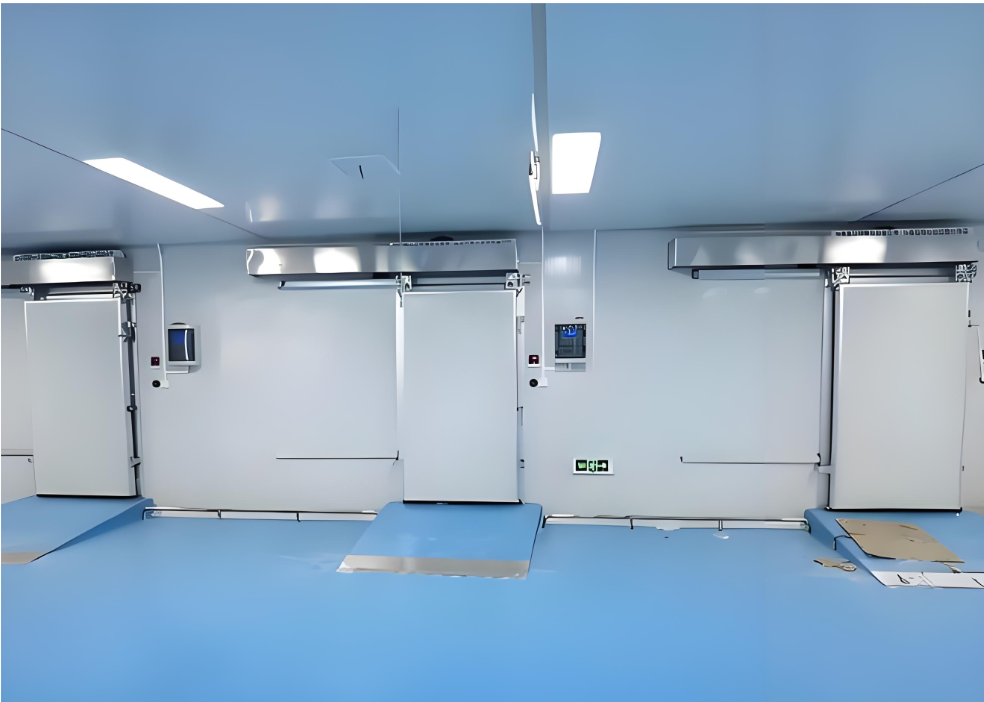
Cold storage panel applications span food, pharmaceutical, logistics, chemical, and agricultural storage environments.
The envelope also has to be planned with its supporting equipment: refrigeration unit, air cooler, tube evaporator, temperature and humidity control system, dehumidifier, fire sprinkler system, cold storage door, loading platform door seal, sealing tape, fasteners, and installation accessories. Core selection without that system map is incomplete — a 0.5mm steel sheet panel with a 100mm core still underperforms if doors, seals, and accessories are not matched to it.
Two material-level details are relevant to sustainability documentation. The panel uses a closed-cell structure that helps prevent water vapour penetration, which protects long-run insulation stability in high-humidity cold rooms. It also uses a CFC-free foaming agent, which connects directly to the environmental criteria that green building assessments and cold chain tenders now score.
PU vs PIR Head-to-Head on a Cold Chain Project’s Constraint Set
On the JSGREEN001 platform, PU and PIR differ in how the specification is declared and certified, not in panel geometry. Both are offered at 50mm or 100mm thickness, with 0.5mm steel sheet facings, 960mm or 1100mm effective width, and ≤0.024 W/(m·K) thermal conductivity, with B1/B2 fire rating options across the range and a B1-grade fire-retardant PIR configuration designated in the family.
| Decision dimension | PU core option (JSGREEN001) | PIR core option (JSGREEN001) | What to confirm before ordering |
|---|---|---|---|
| Core material | PU core over rigid polyurethane | PIR core over rigid polyurethane | Declared core type on the datasheet and in the contract specification |
| Fire rating options | B1 / B2 available across the panel range | B1 / B2 available, with a B1-grade fire-retardant PIR configuration designated in the range | Match the declared rating to the project fire requirement and local code |
| Thermal conductivity | ≤0.024 W/(m·K) | ≤0.024 W/(m·K) | Apply the value against the specified thickness |
| Facing steel sheet | 0.5mm steel sheet | 0.5mm steel sheet | Confirm colour and steel material if customized |
| Panel thickness | 50mm or 100mm standard; 50mm–200mm on customization | 50mm or 100mm standard; 50mm–200mm on customization | Calculate against the -50°C to +15°C room class |
| Effective width | 960mm or 1100mm | 960mm or 1100mm | Align module width to room dimensions to reduce cutting waste |
| Primary application set | Agriculture, chemical, logistics & warehousing, pharmaceutical, food & beverage | Agriculture, chemical, logistics & warehousing, pharmaceutical, food & beverage | Confirm the sector-specific hygiene, corrosion, and temperature duty |
Reading the table as a decision rule
When a project’s fire requirement maps to a B1-grade fire-retardant declaration, the PIR configuration is the one to specify — and the one to verify against the certificate and datasheet. When the binding constraints are the temperature band, humidity, and hygiene requirements, and the available B1/B2 rating already satisfies the project, a PU core inside the same platform keeps the specification simpler and reduces the number of variables to justify.
What should not drive the decision is a slogan. Statements such as “PIR is always better” or “PU is always cheaper” cannot be validated without fixing the core, the declared fire rating, the thickness, the facing, and the accessory set. On the same platform those variables — not the core name alone — determine what the quotation actually contains.
Cost follows the same logic. The main cost drivers are the declared core type, the declared fire rating, panel thickness within the 50mm–200mm customization range, the facing specification including colour and steel material, custom dimensions and lengths, and the cam-lock type. A per-square-metre comparison between a PU and a PIR offer is only meaningful when all of those are fixed on both sides.
Step-by-Step: Specifying a PU or PIR Cold Storage Panel
The sequence below turns the PU vs PIR question into a documented specification. Each step produces an input that a supplier must confirm in writing.
- Fix the temperature band and duty cycle. Position the room inside the -50°C to +15°C working range and confirm whether it is frozen storage, cold storage, or quick-freezing storage. Confirm 24/7 continuous operation, because anti-ageing performance and sealing reliability are evaluated against continuous duty.
- Set the fire requirement first. Decide whether the project needs a B1-grade fire-retardant declaration. If it does, specify the B1-grade fire-retardant PIR configuration; if B2 satisfies the local requirement, both the B1 and B2 options remain available across the range.
- Choose the panel thickness. Start from the 50mm or 100mm standard options and move into the 50mm–200mm customization range only if the room class and energy target justify it. Thickness interacts with the ≤0.024 W/(m·K) conductivity value and with the refrigeration load calculation.
- Confirm the effective width. Select 960mm or 1100mm based on room geometry so that module lines reduce cutting waste and joint count.
- Lock the facing specification. 0.5mm steel sheet is the standard facing. If the project requires a specific colour or steel material, that becomes a customization item to be confirmed before production.
- Map the accessory set. List the refrigeration unit, air cooler, tube evaporator, temperature and humidity control system, dehumidifier, fire sprinkler system, cold storage door, loading platform door seal, sealing tape, fasteners, and installation accessories in the same package so the envelope and the equipment are designed together.
- Verify the documentation. Request the certificates, confirm their scope covers the specified product, and attach them to the specification pack.
- Agree commercial and delivery terms. Confirm the minimum order quantity, production lead time, inspection checkpoints, and after-sales terms, then issue the purchase order against the frozen specification.
Use Cases: Where the Core Decision Plays Out
Cold storage panels in this class are used across five industry groups, and the core decision is usually made within one of them.
Food & beverage
Meat, seafood, dairy, fruit, vegetable, and beverage processing plants operate a mix of freezer and chiller rooms, which makes both the temperature band and the hygiene surface specification binding. In a documented Australian food and meat processing project, 5,000 m² of cold storage panels were installed for a 2,000-ton capacity facility running a low-temperature freezer at -18°C alongside a chiller room at 0–4°C. The installation has operated stably for five years, delivering precise temperature control with seamless joints that prevent cold air leakage, and it passed GSP certification.
Pharmaceuticals
Vaccines, medicines, and biological products require strict temperature control and documented compliance. Here the envelope specification is driven by the audit trail: declared panel performance, clean and hygienic surfaces, and certificates that can be attached to the qualification file.
Logistics & warehousing
Cold chain logistics centres, distribution hubs, and supermarkets frequently need multi-temperature rooms in one building. A 12,000 m² large-scale sorting centre project in Vietnam combined frozen, chilled, and ambient zones. The panels were delivered on schedule, installed with ease, and effectively improved cargo turnover efficiency. High-strength double-sided colour steel sheets combined with precision foaming delivered the flatness and load-bearing capacity the project required, and the standardized modular design increased on-site installation speed by 30% — a measurable reduction in project timeline.
Chemical industry
Storage of low-temperature chemical raw materials adds a corrosion dimension, particularly for facilities exposed to aggressive indoor atmospheres or coastal conditions.
Agriculture
Seed storage and agricultural product preservation typically involve smaller rooms and pre-cooling facilities, where the same platform logic applies but at a smaller module scale.
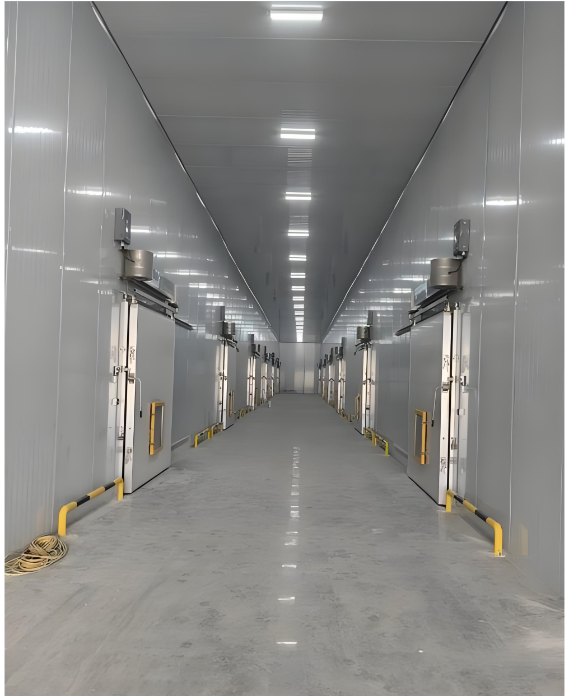
Food processing cold rooms combine freezer and chiller duty, making core and fire rating decisions interdependent.
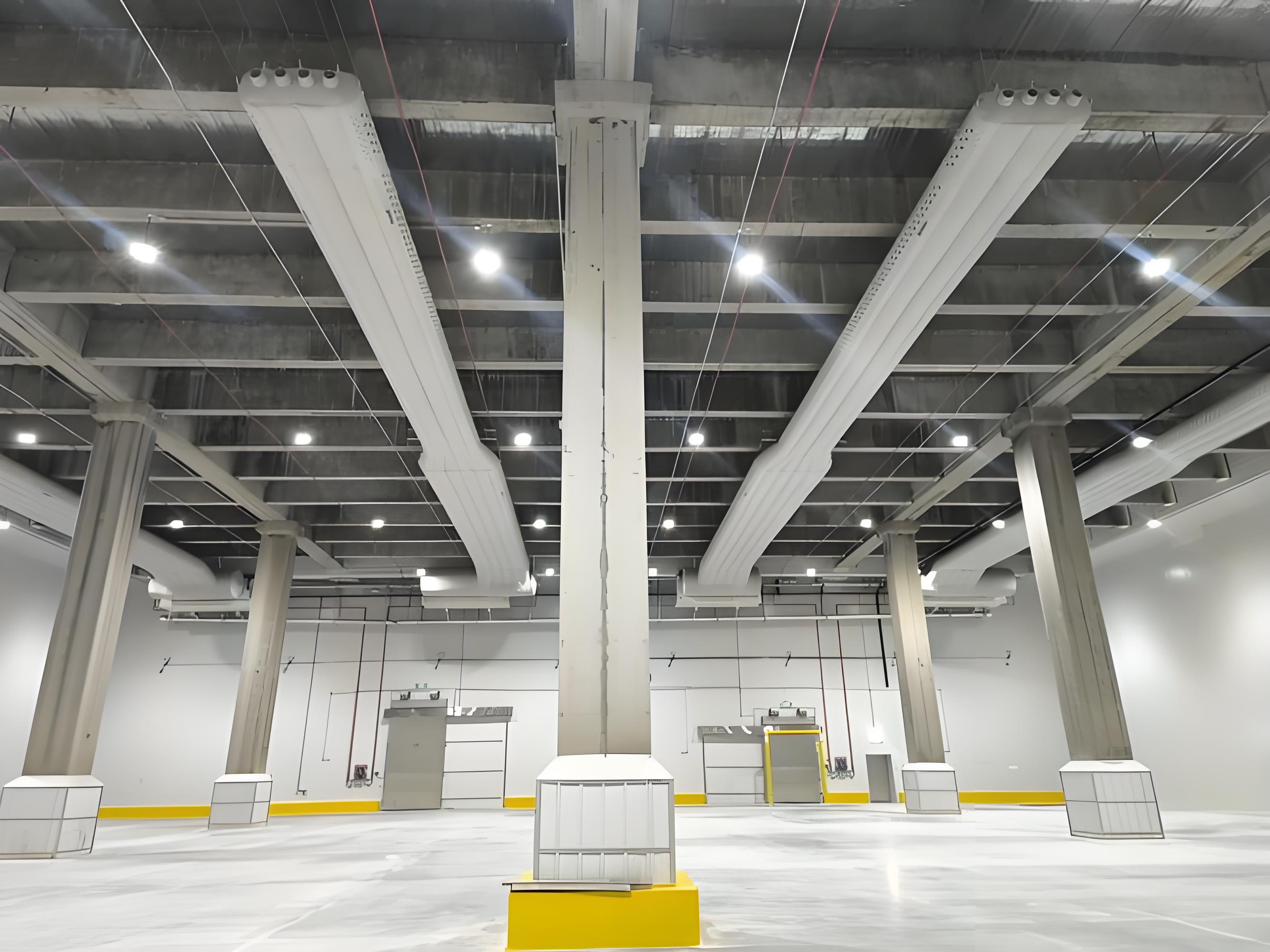
Multi-temperature logistics centres use the same panel platform across frozen, chilled, and ambient zones.
Compliance and Documentation: What to Attach to the Specification
For the JSGREEN001 cold storage panel family, the available management system certifications are:
- ISO 9001:2015 (GB/T 19001-2016 idt ISO9001:2015) — certificate number NO.110825Q0383R0S
- ISO 14001:2015 (GB/T 24001-2016 idt ISO14001:2015) — certificate number NO.110825E0251R0S
- ISO 45001:2018 (GB/T 45001-2020 idt ISO45001:2018) — certificate number NO.110825S0254R0S
All three are issued by Jiangsu Taiding Certification Co., Ltd., are applicable to the global market, and are valid from 2025-09-25 to 2028-09-24. Their scope covers occupational health and safety, environmental, and quality management activities associated with the sales of metal materials and hardware and electromechanical products, and the processing of environmental protection equipment accessories.
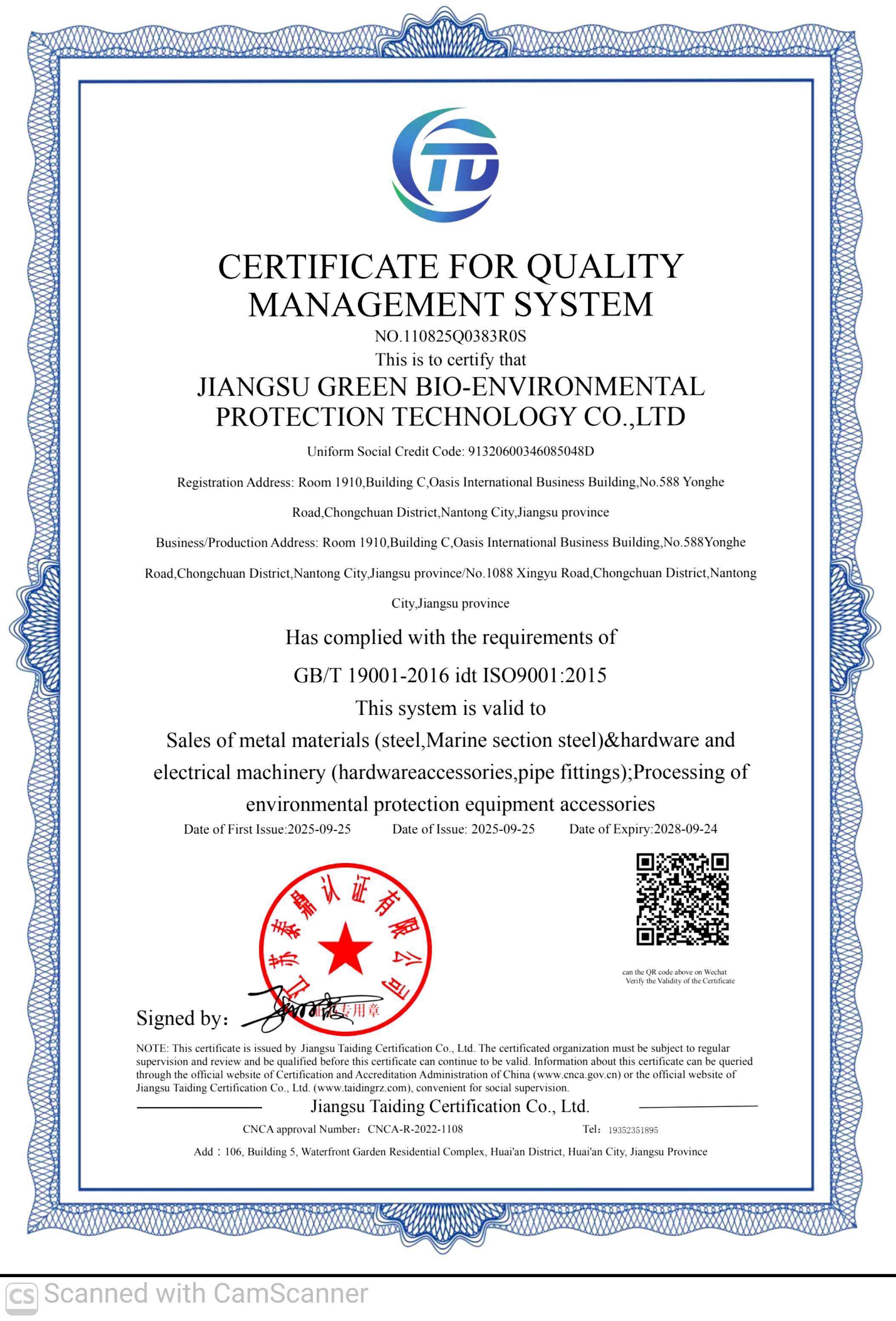
Management system certificates should be requested with certificate numbers and scope, not as generic claims.
Capability Behind the Specification: OEM, Capacity, and Control
A specification is only useful if the supplier can produce to it. GREEN BIO runs OEM/ODM production for the JSGREEN001 platform, with customization covering panel thickness across the 50mm–200mm range, steel sheet colour and material, fire rating, custom dimensions and lengths, and cam-lock types. Monthly capacity is 50,000 m², the minimum order is 100 m² or one 20ft container, and production lead time is 15–25 days after receipt of deposit.
Quality control follows four checkpoints: incoming raw material inspection, in-process patrol inspection, full inspection of finished product density and dimensions, and pre-shipment photo confirmation. After delivery, GREEN BIO provides installation guidance videos, remote technical support, and free replacement of damaged parts during the warranty period — support elements that matter when a cold chain project is commissioned against a fixed schedule.
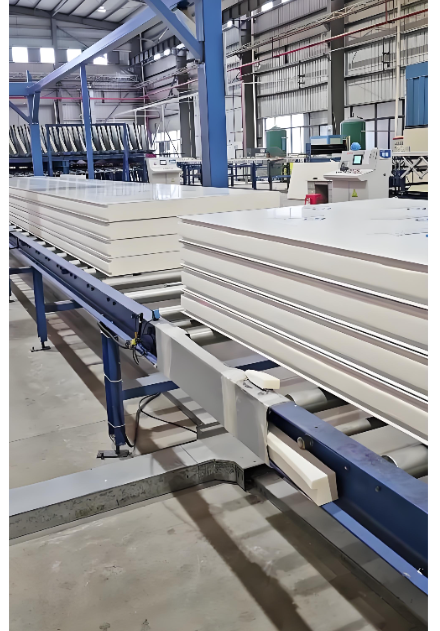
PU and PIR cores are produced on the same platform, which keeps customization within one supply programme.
FAQ: PU vs PIR Cold Storage Panels in Green Building Solutions
What should buyers check when sourcing from CE-certified Green Building Solutions manufacturers?
CE marking is a market-access requirement whose applicability depends on the product and the destination market, so it should never be assumed from a supplier’s general marketing. For the JSGREEN001 cold storage panel family, GREEN BIO holds ISO 9001:2015 (certificate NO.110825Q0383R0S, GB/T 19001-2016 idt ISO9001:2015), ISO 14001:2015 (NO.110825E0251R0S, GB/T 24001-2016 idt ISO14001:2015), and ISO 45001:2018 (NO.110825S0254R0S, GB/T 45001-2020 idt ISO45001:2018), all issued by Jiangsu Taiding Certification Co., Ltd., applicable to the global market, and valid from 2025-09-25 to 2028-09-24. A buyer preparing a cold chain tender should request the certificates themselves, confirm the listed scope covers the specified product and process, and then check separately whether the destination market requires any additional marking.
Can one supplier deliver both PU and PIR cores with custom panel dimensions?
Yes. GREEN BIO operates OEM/ODM production for the JSGREEN001 cold storage panel platform, which is offered with either a PU or a PIR core over rigid polyurethane. Customization covers panel thickness across the 50mm–200mm range, with 50mm and 100mm as standard options; steel sheet colour and material; fire rating; custom dimensions and lengths; and cam-lock types. Monthly capacity is 50,000 m², so both core configurations can be produced within the same supply programme and the same quality control sequence.
What drives the cost of PU versus PIR cold storage panels?
The main cost drivers are the declared core type, the declared fire rating, panel thickness within the 50mm–200mm customization range, the facing specification (0.5mm steel sheet as standard, plus colour and material choices), custom dimensions and lengths, and the cam-lock type. Because those variables sit inside one platform, a PU and a PIR quotation are only comparable when core type, fire rating, thickness, effective width, and accessory set are fixed on both sides. Price bands should be requested against a written specification rather than against a generic “cold storage panel” description.
How can a PU or PIR panel be validated before a full cold chain order?
Validation starts with the production controls behind the panel: incoming raw material inspection, in-process patrol inspection, full inspection of finished product density and dimensions, and pre-shipment photo confirmation. GREEN BIO’s minimum order is 100 m² or one 20ft container, which allows a defined first batch to be produced and inspected against the project specification before larger volumes are committed. Samples, inspection records, and a quotation against a written specification can be requested directly from GREEN BIO.
What lead time applies to PU and PIR cold storage panel orders?
Production lead time is 15–25 days after receipt of deposit, supported by a monthly capacity of 50,000 m². After delivery, GREEN BIO provides installation guidance videos, remote technical support, and free replacement of damaged parts during the warranty period. For most cold chain projects the practical next step is to confirm the core type, fire rating, panel thickness, effective width, and accessory set in writing, then request a quotation together with the 2026 GREEN BIO catalogue: download the Green Bio Professional Catalog 2026.
Conclusion: Deciding PU vs PIR on Evidence, Not Preference
For cold chain projects specifying JSGREEN001 panels, the PU vs PIR decision reduces to three questions. What fire rating does the project need to declare, and does it map to the B1-grade fire-retardant PIR configuration? What temperature band, humidity level, and hygiene class must the envelope hold — within the -50°C to +15°C range and at ≤90% relative humidity? And what documentation must be attached to the project file?
Answer those three questions first, and the core type follows. PU and PIR share the same platform geometry — 0.5mm steel sheet facings, 50mm or 100mm standard thickness, 960mm or 1100mm effective width, and ≤0.024 W/(m·K) thermal conductivity — so the specification, not the label, determines performance. Whether the answer is a PU core, a B1-grade PIR configuration, or a mixed specification across multi-temperature zones, the value of the exercise is the same: a cold chain envelope that can be verified, audited, and operated continuously for years.
Request a PU or PIR panel quotation for your cold chain project
Send your temperature band, fire rating requirement, room dimensions, and accessory list, and GREEN BIO will respond with a specification-matched quotation, samples for validation, and the full 2026 catalogue.
Download Catalog WhatsApp Us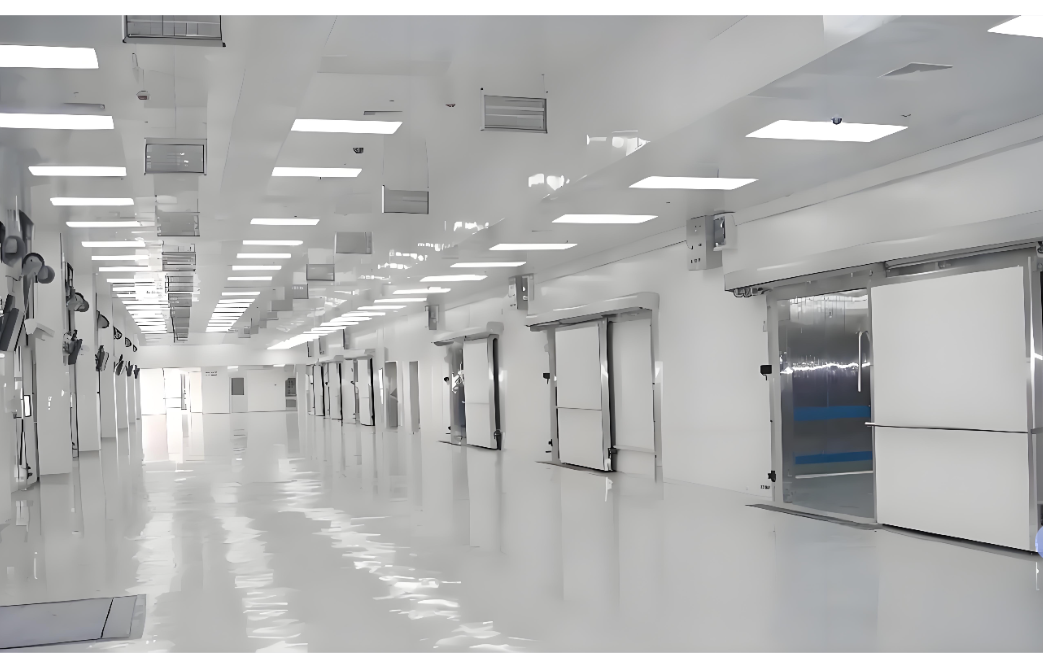
Sample validation and specification-matched quotations are available for PU and PIR core configurations.
Have Questions or Need More Details?
Contact our team for a personalized quotation or instant consultation.
Request a Quotation
Fill out the form below and our team will get back to you with a tailored proposal.
WhatsApp Direct Chat
Prefer to chat in real-time? Message us on WhatsApp for instant assistance & quick answers.
- Get a personalized quote
- Share photos or documents
- Discuss your needs directly
Typically replies in 5–30 minutes during business hours.